
Search built for
the practice of law.
Making primary law searchable, verifiable, and directly accessible.
The Mission
OpenCourt exists to make the law more searchable for lawyers and the general public.
Most search engines were designed with general web search in mind. They match keywords across documents. Conventional legal databases, meanwhile, still rely on similar techniques, locking the material the lawyer actually wants behind the exhausting manual labour of filtering hundreds of unranked hits.
OpenCourt inverts this burden. It applies modern retrieval techniques (i.e., hybrid dense and sparse search, automated citation resolution, and strict source grounding), and OpenCourt fetches the exact law and pinpoint information you need, rather than forcing you to extend your office hours hunting for it.
Building search engines for lawyers
Legal research generally follows a predictable pattern of information searching: firstly, you begin with a general scan of the law on the matter at hand and scope down to a relevant statute or judgment; secondly, you pinpoint the provision or paragraph that is relevant; and thirdly, you check if that piece of law is still good law. Unlike most search engines, OpenCourt’s tools are purpose-engineered to mimic this exact workflow:
| Research Stage | Search Tool | Workflow Purpose |
|---|---|---|
| Stage 1 General Scan of the Law & Scoping | Search the Law | Surface Singapore and foreign judgments, legislation and gazettes on a legal proposition. |
| Search Hansard | Search Parliament’s debates on Bills and ministerial statements by keyword, from 1955 to 2026, to understand the policy behind a statute. | |
| Look Up a Citation | Turn a case, statute or Hansard citation into the official source document. | |
| Stage 2 Pinpoint the Law | Trace Cross-References | Follow a section’s definitions, “subject to” and “despite” chains, and the provisions that refer to it. |
| Check Citations | Check that each citation in a draft exists, its paragraph pinpoint is real, the case name matches and quoted words are verbatim, to catch quotation errors and AI hallucinations. | |
| Stage 3 Check Good Law | Cited By | List the later judgments that cite a case, newest first, with the latest appellate decisions to read before relying on it. |
| Cases on a Section | List the Singapore judgments that cite a statutory section, so you can read how the courts have dealt with it. |
Digital Access to Justice
For the legally trained, it is not uncommon for friends or family nowadays to come to you asking, “I ask you hor, my AI say this and that about the law, can check if real or not?” While endearing (or annoying) at times, such questions highlight the role that AI plays today when it comes to access to justice. In recent times, laypeople are increasingly relying on AI or AI overviews to answer their legal questions. Some self-represented litigants even use AI to present submissions in court.
In my evaluation, which I share in a post in the Journal section, I find that AI overviews and some government-provided AI bots have a strong tendency to give incorrect legal answers. That concerns me, and after evaluating them, I find that the limiting factor is not the intelligence of the AI model used, but a retrieval layer issue. In other words, the AI’s system for retrieving information leaves much to be desired. That is the digital access to justice gap that OpenCourt aims to plug.
It is for this reason that OpenCourt will always provide free searches for lay users, operating both as a standalone search engine and as a convenient add-on to commonly used AI tools like ChatGPT and Claude to augment them to produce responses that, in fact, accurately reflect the law.
The Founder
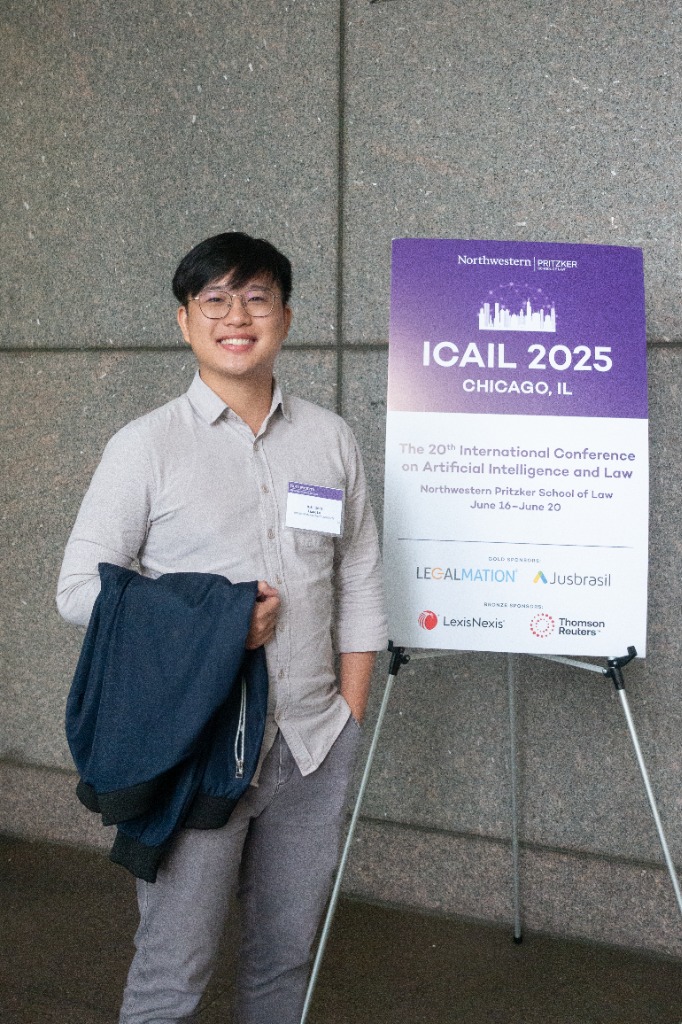
Isaac Lu Yang
Isaac is a Bachelor of Laws graduate from Singapore Management University (LLB, Magna Cum Laude). His legal training spans the full spectrum of Singapore’s legal and regulatory landscape, with specialised academic focus on artificial intelligence law, legal information systems, and technology regulation.
He has spent years building deep, practical expertise at the intersection of law and AI:
- Deployed in Public Service: Built and deployed Factsmith, an AI research and information-extraction system for family-law judgments, at the Legal Aid Bureau of Singapore’s Ministry of Law.
- Academic Research: Presented research on AI-powered research tools in dispute resolution and family law at the 20th International Conference on Artificial Intelligence and Law (ICAIL 2025, Chicago), and research on AI hallucination evaluation at TechLaw.Fest’s Computational Legal Studies 2026 workshop.
- Honours & Awards: Winner of the Clifford Chance Award for Law & Technology Book Prize (2026), and the Dentons Rodyk Access to Justice Award at SMU’s Law Innovation & Technology Hackathon (2023).
- Production AI Stress-Testing: As a Legal AI systems evaluator at a legal-tech startup, he stress-tested generative and retrieval AI systems built for the legal, medical, and insurance sectors, issuing and implementing recommendations to improve the system.
Want to know more about Isaac’s past work? Click here to find out more at isaaclu.com ↗