Research — Working paper
Cited but Unsupported: Modernising Hallucination Testing for Retrieval-Augmented and Web-Enabled Legal AI in Singapore
Six AI research tools answered 102 demanding questions of Singapore law. Nearly three in four answers contained a mistake or cited a source for something it does not say, including two in three of the answers that were right in substance.
Abstract
Legal research systems can retrieve genuine authorities but misstate what they establish. We evaluate six Artificial Intelligence research tools using 102 demanding Singapore legal questions. The question categories include adapted legal hallucination and new questions on precedent relationships, judicial reasoning, factual distinctions and statutory changes. We separately graded incorrectness and misgroundedness from citation precision, verification difficulty and completeness. Results show that 447 responses contain an established inaccuracy or unsupported attribution, totalling a response-level hallucination rate of 73.0%. Of the 399 responses that were substantially correct in their central answer, 269 (67.4%) nevertheless contained a hallucination; viewed from the opposite denominator, those same 269 responses constitute 60.2% of all hallucinated responses. The hardest tasks concern the status and scope of legal propositions.
Artificial intelligence · hallucination · Singapore
- Workshop
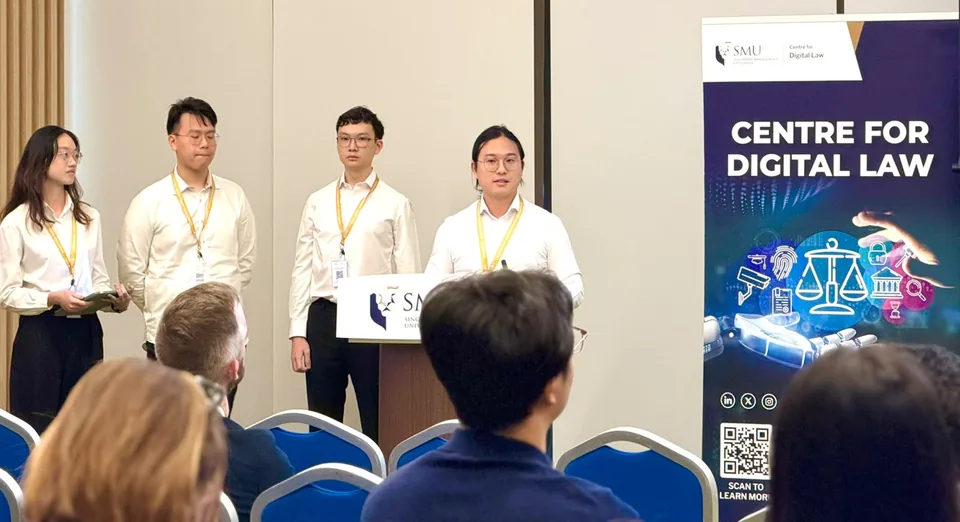
- 5th Computational Legal Studies Workshop (CLS 2026), hosted by SMU’s Centre for Digital Law as part of TechLaw.Fest
- Where
- Singapore · 7–8 September 2026
- Authors
- Five, from Singapore Management University
- Tested
- Six AI research tools, specialised and general-purpose
- Status
- Working paper